3.7 Refining Tone and Expanding Range
Essential Question: How does a brass player expand their range and play different dynamics?
Brass players spend a lifetime refining their tone throughout the range. This lesson introduces the foundational anatomical adjustments necessary to play different notes at different dynamics. Each player will need to experiment and practice to find their best sound. As a teacher, your job is to guide the student in their experimentation and provide constructive feedback and exercises as their sound matures.
Note: though some of these diagrams mention only one brass instrument, the concepts are relevant to all brass playing.
Embouchure Muscles
Beyond mouthpiece placement basics, there are several muscular habits that shape a healthy brass embouchure, and a basic understanding of facial musculature can be helpful. The embouchure involves creating a strong scaffolding with the muscles around the mouth so that the aperture can remain flexible, much like a circus tent or hammock: strong poles support a flexible fabric stretched between them. Horn player and pedagogue Philip Farkas describes a healthy embouchure as a "puckered smile." The puckered smile finds the middle ground between smiling and kissing—too much smile thins and stretches the lips (risking injury, a bright or edgy tone, and poor endurance), while a slightly fuller, more puckered embouchure tends to have better tone and stamina. This balance also shapes the lip aperture: a flat chin and an aperture shaped like an oboe reed opening are signs of a healthy setup, while a bunched-up chin or too much lip inside the mouthpiece ("clamping") flattens the aperture and dulls the tone.
The upper lip is strong but relatively inflexible and should serve as the embouchure's anchor, staying flat and engaged at all times—an over-puckered upper lip becomes weak and prone to injury. The lower lip is much more flexible by comparison and can be considered the "driver" of the aperture.
Firm, stable corners combined with active center-lip muscles give good aperture control across registers. The corners should stay in the same place throughout the range, with the intention of using the same mouthpiece pressure across registers—if measured, more pressure is certainly used in the high range, but the contact between the mouthpiece and the lips should feel constant. If the top of the range won't speak without extra mouthpiece pressure, it's often a sign that the embouchure is too stretched, like a smile, and adding more pucker can help. Pressure itself should be used sparingly: increasing pressure shrinks the aperture and can produce higher notes, but at the cost of tone, endurance, and injury risk, so high notes should come from focused air and lip muscles rather than squeezing.
Finally, most players do best with wet (moist) lips, which let the mouthpiece settle naturally while allowing enough flexibility to adjust freely between registers. A moist lip also adds vibration, as in the saying "wet your whistle."
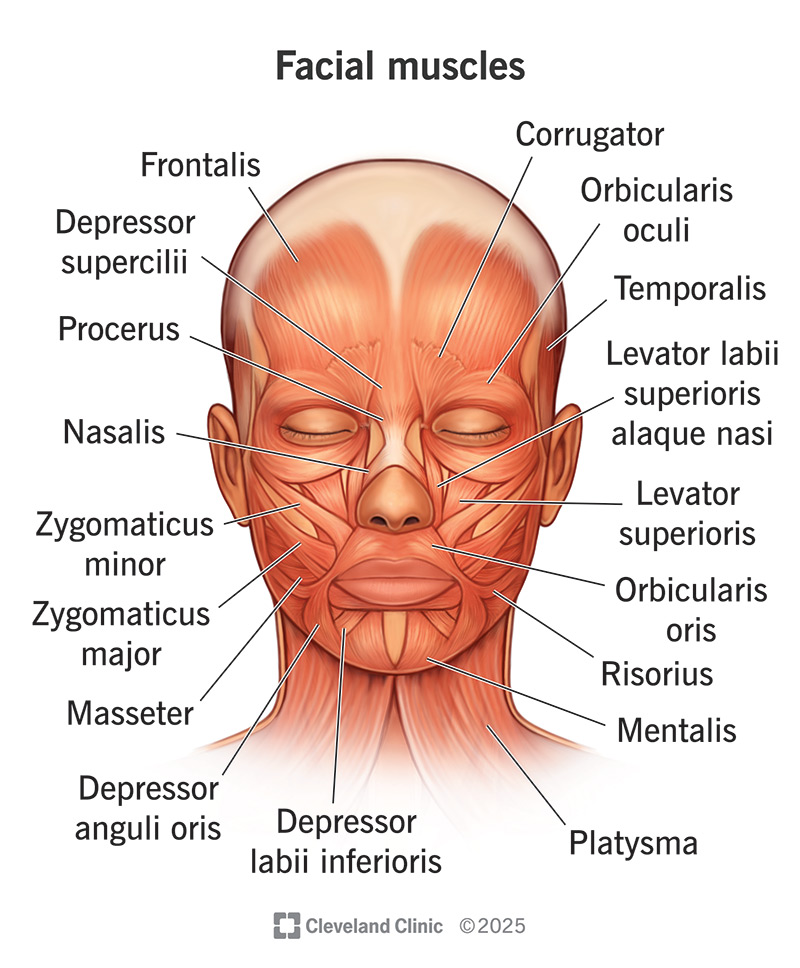
Facial muscles (Cleveland Clinic)
Knowing where these muscles sit can help give students more precise feedback:
- Orbicularis oris — the ring of muscle around the mouth that purses and rounds the lips. This is the primary "pucker" muscle and forms the lip aperture.
- Zygomaticus major and minor and levator anguli oris — the "smile" muscles that pull the corners of the mouth up and back. Some engagement firms the corners, but too much thins the lips and widens the aperture.
- Risorius — also pulls the corners back, helping keep them firm and stable (the "mmmm" position) without collapsing into a full smile.
- Buccinator — the cheek muscle that holds the cheeks against the teeth, keeping air directed into the mouthpiece instead of puffing out the cheeks.
- Depressor anguli oris and depressor labii inferioris — muscles around the chin and lower lip.
- Mentalis — the muscle in the center of the chin. Keeping it engaged helps maintain the flat chin.
- Levator labii superioris and levator labii superioris alaeque nasi — lifts the upper lip and opens the nostrils. Flexibility here supports a strong, slightly raised upper-lip placement.
- Masseter — the main jaw-closing muscle. It should stay relaxed enough to allow the slightly forward jaw position without clenching.
Changing the Shape of the Mouth: "Changing the Vowel Sound"
Just like when we are speaking, we can change the vowel sound by changing the shape of the mouth. Whether the sound is created by the vocal chords or buzzing lips, the mouth shape determines the quality of sound. We change the vowel sound (for speaking and wind playing) by lowering/raising the jaw and adjusting the tongue position.
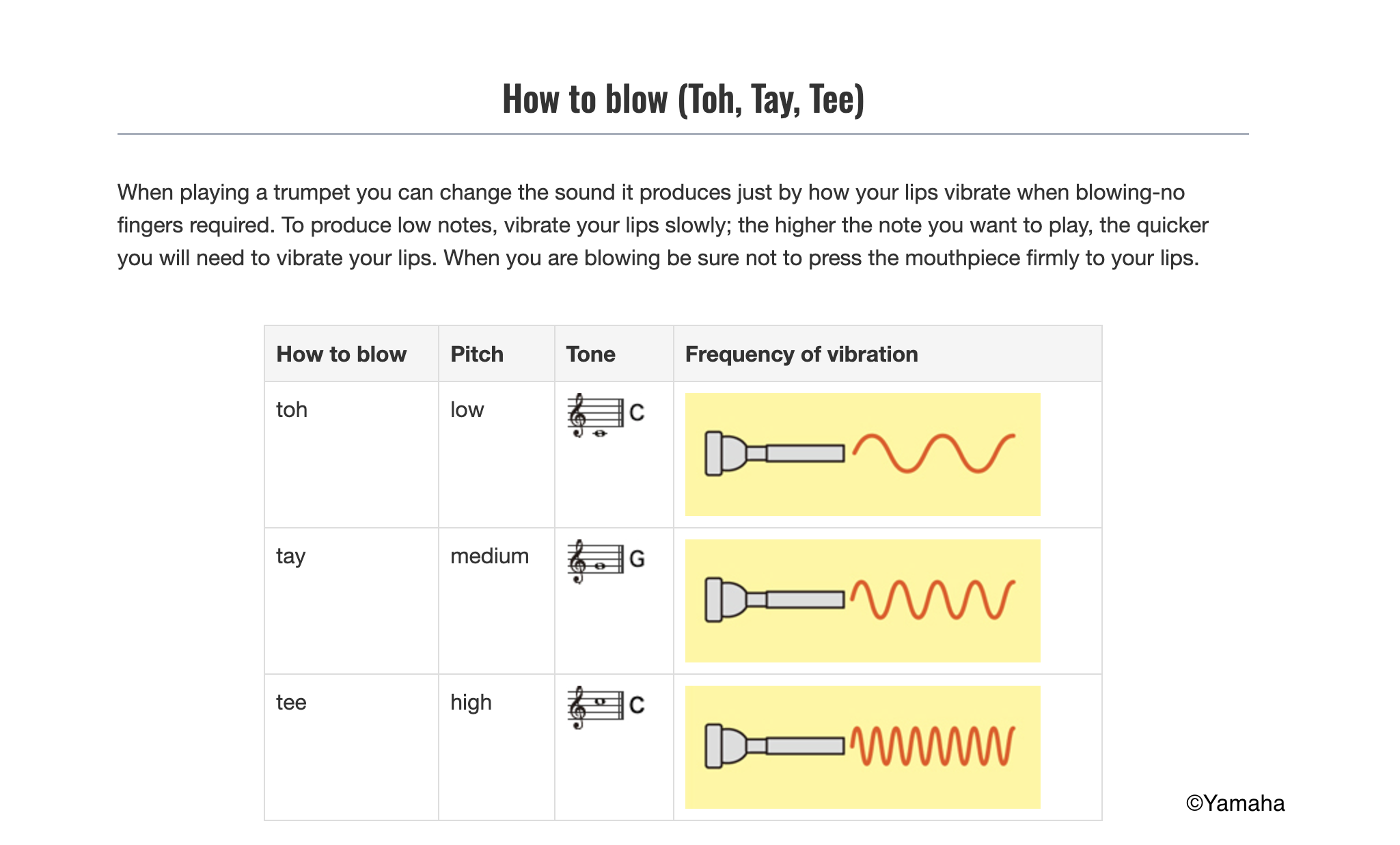
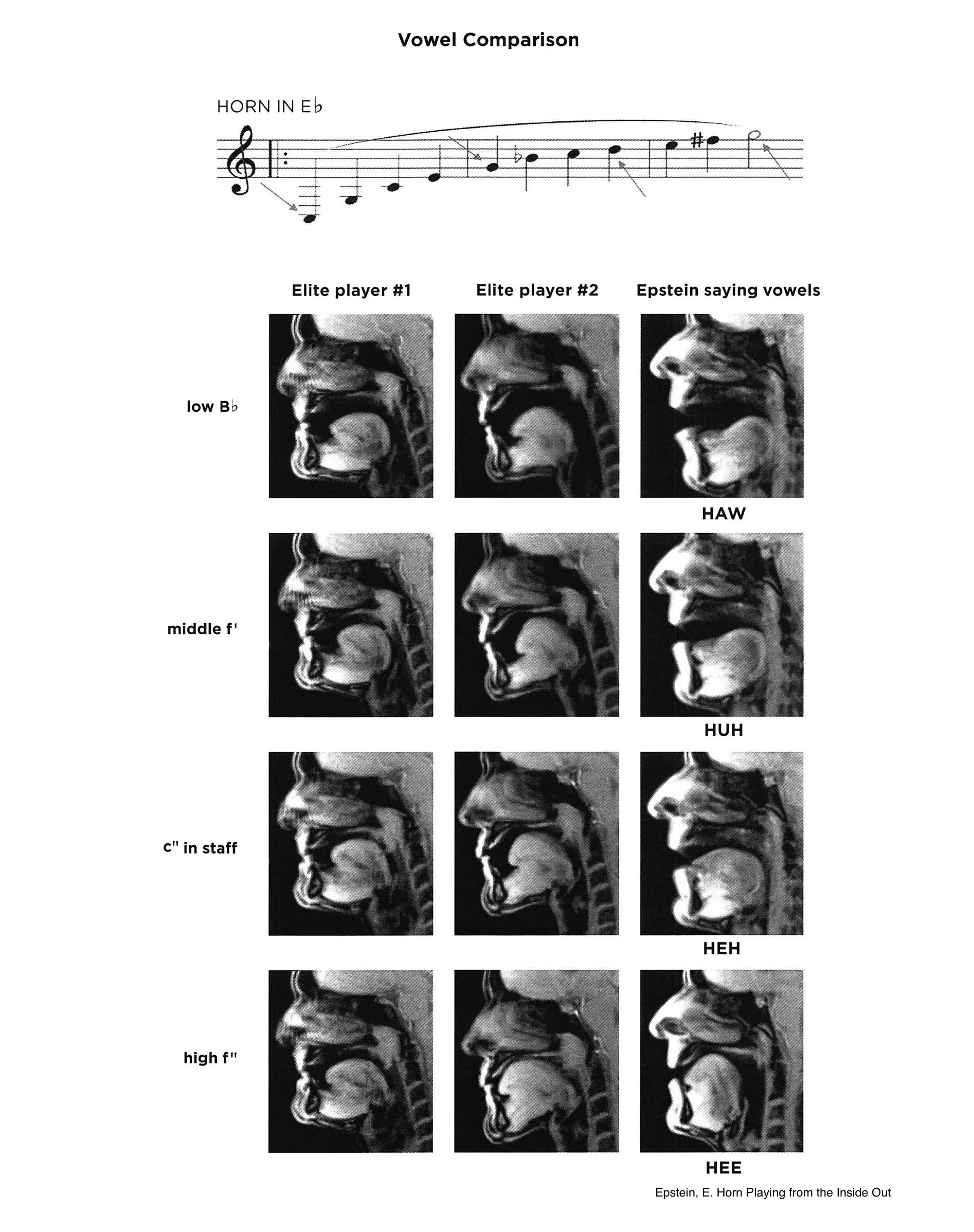
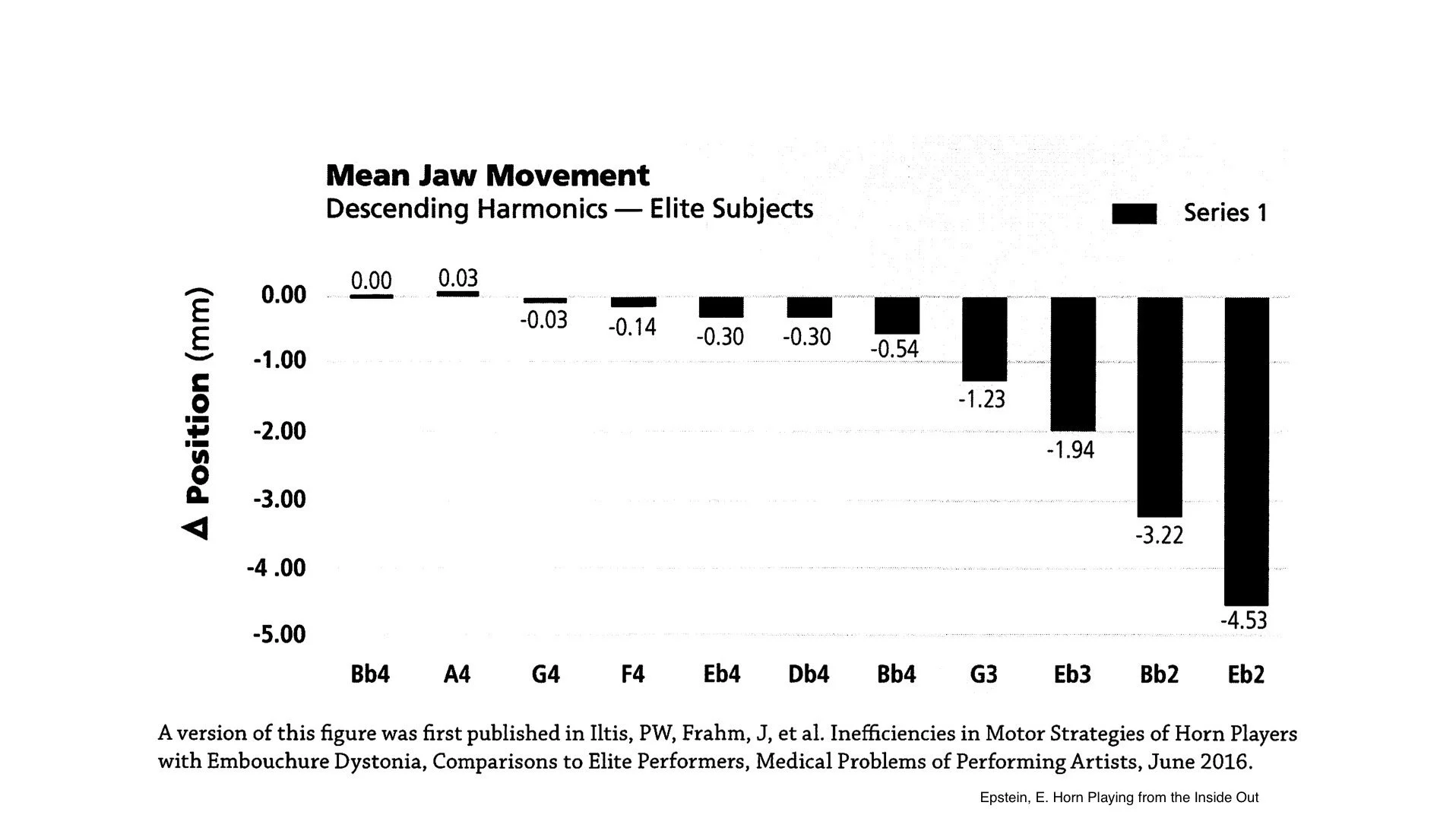
Using the Jaw and Directing the Air
Dropping the Jaw
To descend into the lower registers of brass instruments, opening the jaw is critical. As the jaw opens, the top and bottom teeth become further apart. Be careful not to overly open the aperture, though, or the buzz will stop.
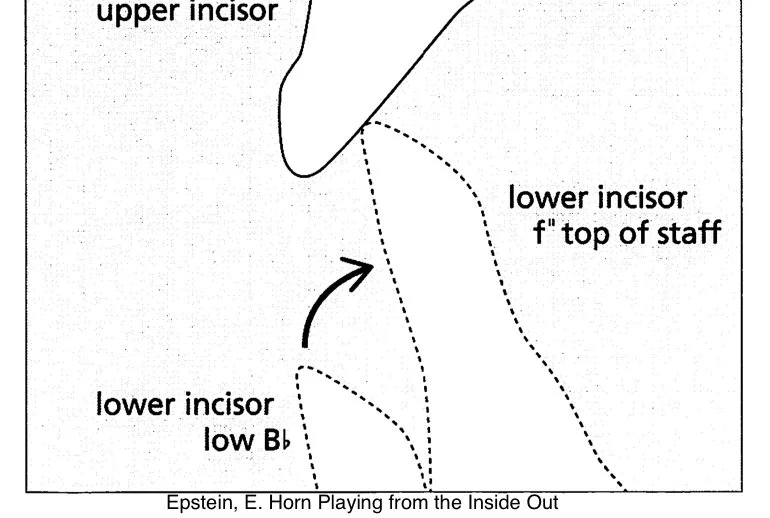
The Pivot
Changing the direction of the air by pivoting the leadpipe or slightly adjusting your head can facilitate greater control throughout the range.
- Generally, a downstream air direction into the horn (leadpipe angled down slightly) facilitates faster sound wave so is useful for the high range
- Generally, a straighter air direction into the horn (leadpipe straighter off the lips) facilitates slower sound waves so is useful for low notes
Balancing Air Speed and Lip Tension
Here's an oversimplified, but useful thought experiment.
A note "X" =lip tension+air speed
- If you increase lip tension and keep air speed constant, the pitch will pop up to the next partial higher.
- If you keep the lip tension constant but increase the air speed, the pitch will also pop up to the next partial higher.
- In order to get louder without changing the pitch, you must increase the air speed and compensate with a decrease in lip tension
- To move to a softer without changing the pitch, you must decrease the air speed and compensate by increasing your lip tension.
In reality, the size of the mouth, the jaw position, and volume of air complicate the equation, but this basic idea holds. It's all about finding the right balance of these elements to produce the pitch, sound, and volume you desire.
Helpful Prompts
High Range
- High pressure, low volume
- Fill lungs fully and use the natural recoil of the intercostals to power the high register.
- Faster air-- blowing out birthday candles
- Imagine a narrower airstream
- Increase the lip tension slightly and make the aperture smaller by push the corners forward.
- Lift the tongue arch
- Tilt the mouthpiece off upper lip slightly
- Increase mouthpiece pressure (a little)
- Slide the mouthpiece and lips across the teeth slightly (up towards your nose or down away from nose)
- Angle the horn leadpipe down slightly
Low Range
- High volume, low pressure air
- Use more air (slower and thicker maybe)
- Warmer air—fogging a window, blowing bubbles
- Darth Vader air on exhale
- Drop the jaw, but keep firm corners
- Flatten the tongue
- Tilt into upper lip slightly
- Push jaw forward (maybe)
- Slide the mouthpiece and lips across the teeth slightly (up towards your nose or down away from nose)
- Angle the leadpipe straighter off your lips
Playing louder and softer
Louder
- Increase air speed
- Allow lip tension to decrease and oral cavity to get bigger as volume and speed of air increase
- Remember to listen to the quality of the sound. Don't overblow it!
Softer
- Decrease air speed
- Allow lip tension to increase and oral cavity to get smaller as volume and speed of air decrease.
- Remember to keep air moving even when playing soft!
Accuracy
- Hear it: whenever possible, hear the pitch you want to hit. Use the harmonies around you or the last pitch you played to hear the note the note before you play it
- Taste it: often you have to enter on a note without a clear harmonic backdrop. For these notes, you must rely on muscle memory and the feel or "taste" of each note
- Practice accuracy and ear training exercises everyday!
Learning Check
4 points possible (ungraded)
1. When playing low notes on a brass instrument, which of the following techniques is most effective?
2. Which adjustment helps produce high notes on a brass instrument?
3. When transitioning from low notes to high notes, how should the jaw and tongue position change?
4. A student struggles with producing clear low notes. Which advice would most likely help?